Associative Memory Is Back
The most interesting retrieval papers in this year's ICLR submissions are not vector search papers. They are association papers: graphs, multi-signal ranking, evidence paths you can audit. The work keeps circling an idea librarians and one famously systematic German sociologist had long before embeddings existed.
TL;DR. Reading through the memory submissions to ICLR 2026, a pattern jumped out: the retrieval work worth reading is no longer about better similarity search. It is about association. AssoMem ranks memories by mixing relevance with importance and temporal alignment. SGMem builds sentence graphs that connect memory across turn, round, and session granularities. PolicyRAG walks a typed graph with editable policies and produces evidence-path traces you can inspect. BrowseNet benchmarks graph traversal plus embeddings for associative retrieval. A fifth submission builds an association and selection loop over multi-granularity memories. Five groups, five methods, one direction: similarity tells you what a memory looks like, association tells you what it is connected to, and agents need the second thing. The Zettelkasten crowd was right all along.
For about three years, retrieval in the LLM world has meant one move. Embed the query, embed the corpus, take the nearest neighbors by cosine similarity, hope. Much of the RAG industrial complex is that move with increasingly elaborate garnish. And for three years it has had a known, nagging weakness that everyone works around and few name plainly: similarity is not connection.
The memory papers submitted to ICLR 2026 name it. Not one paper, a cluster. When several unrelated groups lean the same architectural way in the same season, I sit up. Five submissions are a signal, not a census, but I want to lay out what I read into the signal.
Similar Is Not Connected
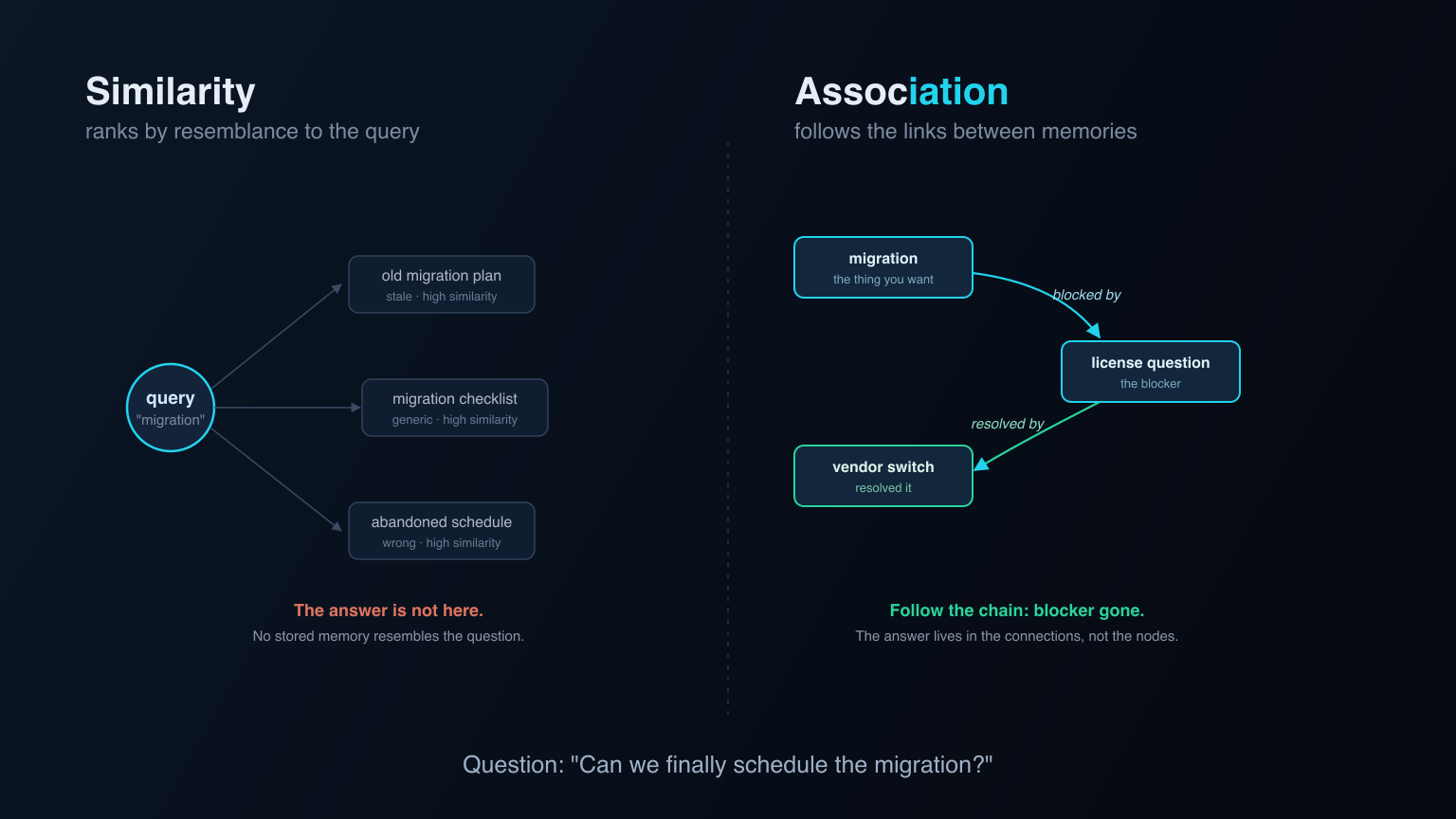
Here is the failure in one example. Suppose an agent stored these three memories over a month. The user is migrating a service to a new database. The migration was blocked by a licensing question. The licensing question got resolved by switching vendors. Now the user asks: can we finally schedule the migration?
Pure similarity search retrieves memories that resemble the query. It will happily surface everything about migrations, including stale plans and abandoned schedules, because they all embed near the word migration. What the question actually needs is a chain: migration depends on the license question, the license question was resolved, therefore the blocker is gone. No single memory resembles the question. The answer lives in the connections between memories, and cosine similarity does not explicitly represent or traverse the dependency chain the question requires. It ranks by resemblance.
Every experienced RAG builder has met this failure. The standard patches, query rewriting, HyDE, reranking, are attempts to make similarity behave more like association without building the associations. The ICLR crop suggests at least part of the field is done patching and has started building.
The Convergence, Paper by Paper
AssoMem: Scalable Memory QA with Multi-Signal Associative Retrieval is the cleanest statement of the multi-signal idea. It builds an associative graph over memories and retrieves by combining relevance with importance and temporal alignment rather than letting similarity carry everything. That trio matters. Relevance is what vector search already gives you. Importance and temporal alignment are properties of the memory network itself, signals that only exist because there is structure to read them from.
SGMem: Sentence Graph Memory for Long-Term Conversational Agents attacks granularity. It connects sentence-level memory across turns, rounds, and whole sessions, mixing raw dialogue with derived facts, summaries, and insights in one graph. The lesson I take from it: conversations span several scales at once, so a memory system likely benefits from representing more than one. A related submission, From Single to Multi-Granularity: Toward Long-Term Memory Association and Selection of Conversational Agents, pushes the same theme with an explicit association and adaptive-selection loop, which is about as direct a commitment to association-as-mechanism as a paper title can make.
PolicyRAG: Prompt-Guided Symbolic Graph Memory for Interpretable Multi-Hop Retrieval adds the property I care most about, and I will give it its own section below: the traversal is interpretable. Typed graph, Personalized PageRank, editable retrieval policies, and evidence-path traces.
And BrowseNet: Knowledge Graph-Based Associative Memory for Contextual Information Retrieval does the unglamorous work of benchmarking the premise, knowledge-graph association plus embeddings for associative, contextual retrieval. Unglamorous and necessary, because a convergence of architectures without a convergence of measurements is just fashion.
The Old Idea Underneath
None of this is new, which is exactly why I trust it. Association as the organizing principle of memory is one of the oldest ideas in the study of thought, and its most extreme practitioner was Niklas Luhmann, the sociologist whose Zettelkasten, roughly ninety thousand numbered slips, each linking to other slips, became the engine of his theory and his publishing. The famous thing about the Zettelkasten, at least as Luhmann told it, is that the value lay in the links as much as the notes. He described the system as a communication partner that surprised him, and the surprise came from following association chains he had built but could no longer hold in his head.
Replace slips with memory items and links with typed edges and you have described the architecture this ICLR cluster is converging on. We named one of our own memory types zettel for exactly this reason, and I wrote about the broader taxonomy in Five Types of AI Memory. The intellectual lineage is not decoration. It is an old hint about where associative recall comes from, and my ungenerous read, offered as a read and not a survey, is that the embedding era set it aside because embeddings were new and slips of paper were not.
Why This Matters More for Agents
I said similarity fails on connection-shaped questions. The reason this is urgent now, rather than a curiosity, is that agents ask connection-shaped questions constantly. A chatbot retrieving a support document can live on similarity. An agent that acts over weeks is far harder to serve that way, because action depends on state, and state is relational. What is blocked by what. What supersedes what. What was decided, and what that decision depended on, and whether the dependency still holds. Every one of those is a hop across an association, not a lookup by resemblance.
Most of this association work shows up in memory systems rather than generic RAG, though not all of it, since PolicyRAG carries the same concern into retrieval broadly. Memory does hold one quiet advantage. It retrieves from a history the agent itself accumulated, where the connections were observable at write time, and you can build associations cheaply when you witnessed them forming. The new work exploits exactly that.
Retrieval You Can Audit
The PolicyRAG property deserves its own flag, because I think it points at where this all goes. When retrieval is a graph traversal, the system can hand you the path it walked: started here, followed this edge because of this policy, arrived there. An evidence path. Compare that to a cosine score, which is a number with no story attached.
I have argued before that retrieval is a trust boundary, and evidence paths are what inspection looks like on that boundary. An auditable traversal can be debugged, challenged, and constrained by policy. A similarity score can only be believed or not. As agents take actions with real consequences, I do not think opaque retrieval survives contact with serious deployments, and association-based memory is the most credible route to transparent retrieval I have seen so far.
Where I Land
Vector search is not going away, nor should it. Resemblance is a genuinely useful signal, and several of these systems keep embeddings in the mix alongside their graphs. The change is that similarity is being demoted from the retrieval mechanism to one signal among several, alongside importance, recency, type, and the structure of the association graph itself. Fusion of signals, not worship of one.
The bet we placed on graph-shaped, association-first memory was placed before this literature existed to comfort us, and I will not pretend the comfort is unwelcome. But the more useful takeaway is for anyone building on flat retrieval today: in this year's memory research, the center of gravity sits over association. What is similar was always the easy question. What is connected was always the real one, and it finally has a research program worthy of it.