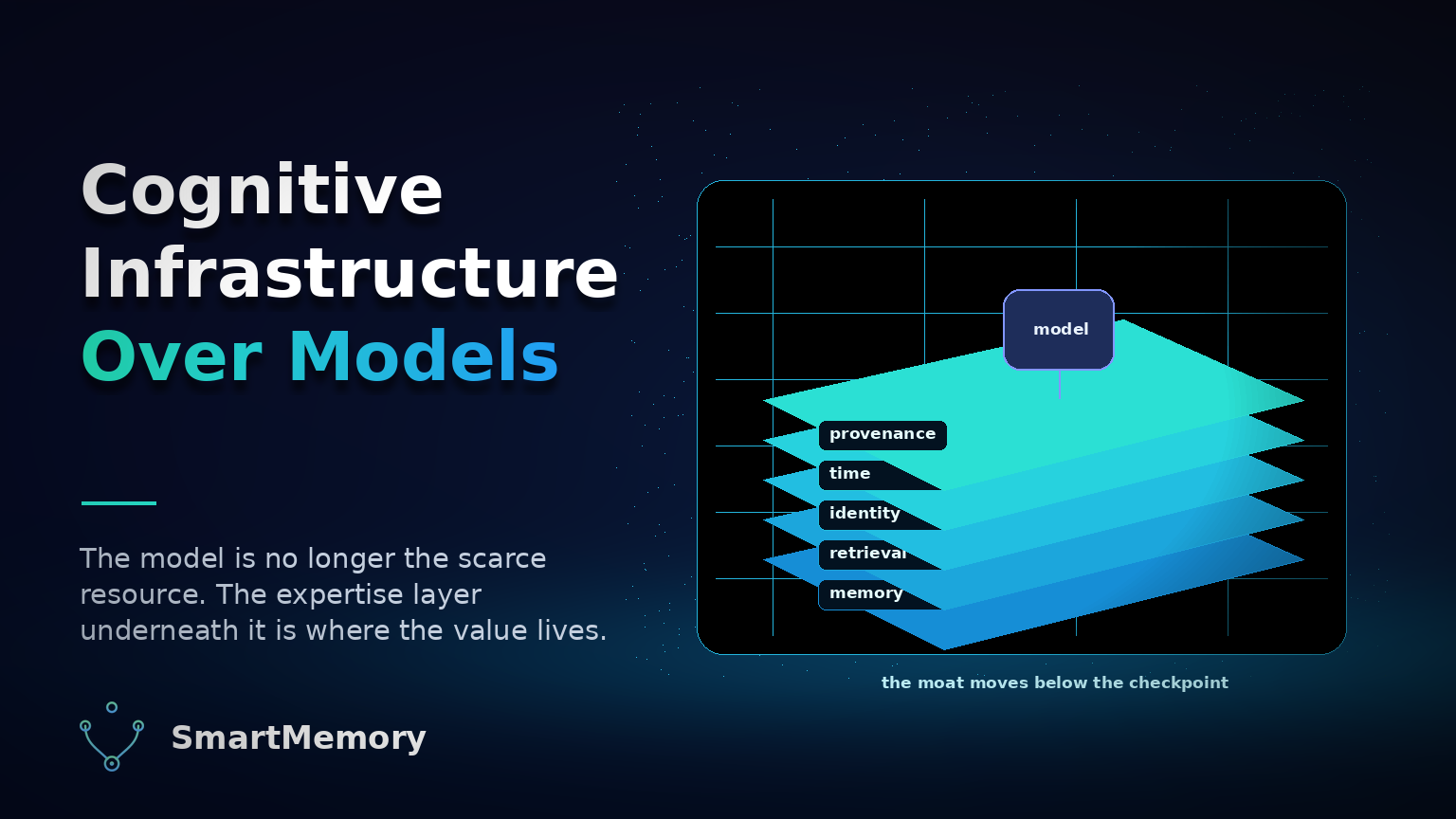
Cognitive Infrastructure Will Matter More Than the Next Model
The model is no longer the scarce resource. The expertise layer underneath it is where the value migrates.
By the time most of us shipped our first thing on Postgres, nobody had to argue us into it. The argument was over. A few years earlier it would have been a fight.
In the late nineties the interesting question was the language. Which runtime, which framework, which clever way of structuring a program. We argued about it the way people argue about models now, with conviction, in public, as if the answer would settle everything. Then the question quietly stopped being the language. The applications that survived and scaled were the ones that put a real database underneath and treated the data as the thing that mattered: durable, consistent, queryable, auditable. The language became a detail you swapped out. The data layer became the moat. Nobody chose Postgres because it was exciting. They chose it because the application was only as trustworthy as the state beneath it, and that turned out to be the whole game.
We are at the same hinge right now with agents, and almost everyone is still staring at the wrong half of the system.
Over the course of this series I've been writing about one problem from a different angle each time, and this is the essay where I say the thing the others were circling. The industry is obsessed with the model. The bottleneck is moving. The next generation of AI systems will be limited by what the agent remembers, who it thinks it's talking to, where its facts came from, and whether anyone can tell when those facts went stale. All of that comes before model quality. The layer that handles it isn't the model, and isn't the prompt. We don't have a settled name for it. I've been calling it cognitive infrastructure, and it's about to matter more than the next checkpoint.
The model is no longer the scarce resource
The uncomfortable news, for anyone whose roadmap is a list of model upgrades: the model is the part of the stack improving fastest and commoditizing fastest at the same time. Every few months a better one arrives. Several vendors ship something close to state of the art. The capability you were going to differentiate on is, within a quarter or two, table stakes that anyone can rent by the token.
That is exactly what happened to the programming language. It got good enough, then abundant, and the moment something is both good and abundant it stops being where the value lives. Value migrates to whatever is scarce and hard. In application software that was durable, trustworthy state. In agentic software it's the same answer wearing different clothes. The substrate the agent reasons from is what matters: what it has remembered, where that came from, and whether it still holds.
Watch what actually breaks in production. It is almost never "the model wasn't smart enough." It's that the agent confidently acted on something it should not have trusted, or forgot a decision it made last week, or merged two people into one, or followed a runbook that stopped being true eight months ago. In every one of those incidents the model is doing its job faithfully on top of state that lied to it. The model is the witness. The substrate is the culprit.
A series circling one layer
The essays before this one each named the same gap from a different side without ever naming the whole.
I started by arguing that memory is the new attack surface. The moment an agent reads its own persistent state back and acts on it, you have crossed from computation into belief, and beliefs can be poisoned in ways that survive a restart. Then I separated memory from the context window: a bigger window is a larger sheet of scratch paper, thrown away every call, and continuity across sessions is a different problem that needs durable, attributable state. I broke memory into types, because someone said this once and this is true are different facts and a flat vector store erases the difference on the way in. I argued that most agent failures are system failures. The model is the witness. The substrate is the culprit. I called retrieval a trust boundary, because the real question at read time isn't "is this relevant" but "should I believe it." I made the case that time is the missing dimension. A stale fact isn't false, it's false now, and you can't tell the two apart with a single timestamp. I argued that identity is harder than memory, because entity resolution is access control wearing a friendly face. And I ended on the graph, because facts don't fail in isolation. They fail when their relationships, provenance, and temporal context get lost, and a graph keeps those edges first-class.
Read them back to back and the shape is hard to miss. Different essays, same object seen from every side. Where a fact came from and whether you can still trust it. Whether it's true now. What kind of fact it even is. How it connects to everything else, and how it got into the store in the first place. Every one of those is something the model can't supply for itself, because the model is stateless by construction. It rebuilds the world from scratch on every call. They all live in the layer underneath it.
That layer is what I mean by cognitive infrastructure. The reason it doesn't have a settled name is the same reason the database didn't, back when the first applications were bolting state onto themselves by hand. We're early enough that most teams are building it by accident, one undifferentiated vector store at a time, and rediscovering the failure modes the hard way.
Knowledge is what's true. Expertise is what to do.
So here is the distinction the whole thing turns on, stated as plainly as I can.
There is a difference between knowledge and expertise, and it isn't a difference of degree. Knowledge is what's true. Expertise is what to do. A new hire can read every document in the company and still be useless on day one, because the documents encode what is true and almost none of what to do. Which exceptions are safe, which rules are load-bearing, which past decision still holds and which one quietly expired, who is who, what worked last time and what blew up. Expertise is knowledge plus where it came from, plus when it stopped being true, plus a sense of which of your own beliefs you should still trust. It's what you're left with after you've actually done the work, and it's expensive precisely because there's no shortcut to it.
This is the line the whole industry is blurring. The retrieval-augmented stack, the "memory" features bolting onto every coding harness, the vector store with a nice API: those are knowledge layers. They answer what's true (or what was, somewhere in the corpus, at some unspecified time, asserted by someone unspecified). They are genuinely useful and they are not the hard part. The hard part, the scarce-and-difficult part where the value migrates, is the expertise layer: the substrate that remembers not only the fact but the procedure attached to it, the conditions under which it still applies, and the moment it quietly stopped applying.
Call the category the expertise layer. It is not "another AI memory system." Memory is becoming a feature of the harness. Your coding agent has a /memory command, your copilot remembers your name. Those are knowledge conveniences, and they'll commoditize the same way the model did. The expertise layer is the thing underneath that decides whether a remembered fact is even allowed to influence a decision. Where it came from, whether it's still valid, whether it's been superseded, whether the entity it's attached to is even the right entity, and whether you can reconstruct afterward exactly what was believed when. That is the database moment for agents, and it is the part nobody is paying enough attention to.
What the infrastructure actually has to do
Here is where I get concrete, because category claims are cheap and the only test of one is whether it cashes out into mechanism. SmartMemory is an instance of the expertise layer, and it is built deliberately around the gaps this series has named, because each is something the model can't supply for itself.
It tags where everything came from. Every memory carries an origin. Typed by a user, ingested from an API, indexed from code, or guessed by a background process. Origins are sorted into visibility tiers. A speculative derived memory does not get recalled with the same authority as something a human actually said. This is the provenance facet, and it is the difference between knowledge ("this string exists in the store") and expertise ("this is a user statement, trust it" versus "this is a machine's guess, show it but don't act on it"). Write authority and read trust are not the same thing, and the infrastructure has to keep them separate or the agent will eventually act on its own speculation as if you had said it.
It is bi-temporal. Two clocks: valid time (when something was true in the world) and transaction time (when we learned and recorded it). With a single timestamp you can answer neither "is this still true?" nor "what did the agent actually know when it made that decision?" The stale runbook that runs FLUSHALL against the wrong Redis is a valid-time failure. The post-incident audit is a transaction-time question. Expertise is knowledge that knows its own expiry, and you cannot have that with one date field.
It supersedes instead of overwriting. A new fact links to the old one and preserves it. "Flying to Portland in July" becomes "flew to Portland in July" once July passes, reversibly, because the prior state was kept. You cannot audit what you destroyed, and an agent that silently clobbers its own history has no way to learn that it was wrong.
It separates memory into types instead of one vector blob. Episodic testimony, semantic fact, procedural how-to, and the rest are different kinds of thing with different rules. Episodic is append-only and should never be promoted to general truth on its own. Procedural knowledge has to be checked against the actual world because it drifts. Collapse them and you lose the exact distinction expertise is made of: someone said this once versus this is true versus this is how we do it here.
It keeps the structure first-class in a graph. Facts rarely fail alone. They fail because their relationships, provenance, or temporal context evaporated. A graph keeps the edges (which fact superseded which, who asserted it, what it depends on, what it is part of) so the context that makes a memory safe to act on travels with the memory instead of being lost at write time.
And it is observable on the write path. Every ingestion produces a trajectory: the stages it ran through, what each one did, what it cost. Most teams instrument retrieval and ignore writes, which is backwards. Corruption enters on writes. If you cannot reconstruct how a belief got into the store, you cannot defend the store. We learned this the embarrassing way. An early version of the write path logged a single line per ingestion, "ingested item X," which felt like plenty until the first time a derived fact came out wrong and I went looking for where it was born. The log told me the fact existed. It told me nothing about which extraction step inferred it, which prior memories it was conditioned on, or which model produced the bad inference. The belief was in the store and its lineage was gone, and I'd shipped a system that could remember everything except how it came to remember it. Rebuilding that as a per-stage trajectory wasn't a feature decision. It was the price of being able to answer the only question that matters during an incident, which is where did this come from.
I'm not listing those six as a feature checklist. They're what the infrastructure I keep watching teams rebuild by hand needs to provide, whoever builds it. The same way the databases that survived ended up providing durability and consistency and transactions, whether you bought Oracle or wrote your own. With SmartMemory, pip install smartmemory and the whole substrate runs locally, no gatekeeper between you and your own agent's state.
Where the moat actually is
I want to be precise about the strategic claim, because it is the one a founder should be most skeptical of when a founder makes it.
The model isn't the moat. You don't own it and neither does anyone else for long. It improves out from under you and your competitor rents the same one. The prompt isn't the moat either. Prompts are copyable in an afternoon. The moat is the state your agent built up by actually operating in your domain, and the infrastructure that keeps that state trustworthy enough to act on. That state is unique to you. It compounds. It is expensive to reproduce because it was earned over time, in your environment, against your real problems. It is, in the most literal sense, the thing a competitor cannot download.
This is precisely the database lesson, restated. The application logic was always copyable. The schema was copyable. What was not copyable was the years of real data, kept clean and consistent and queryable, that the application sat on top of. The companies that understood early that the data layer was the asset built durable advantages. The ones that treated the database as plumbing spent the following decade in data-quality remediation, which is a polite phrase for paying compound interest on a decision you made carelessly at the start.
Agents are going to repeat this exactly. The teams treating memory as a convenience feature, a vector store wired up at the end, an undifferentiated blob with no provenance, no time, no types, no audit, are taking on cognitive debt that comes due as silent, expensive, hard-to-diagnose failures. The agent that learned the wrong thing and won't let go. The slow-drip poisoning no single-turn test can catch. The cross-tenant leak that looks completely normal in the logs. The teams treating the expertise layer as infrastructure, designing for provenance and time and observability from day one, are building something that gets more defensible the longer it runs, because trustworthy accumulated state is the rare thing that appreciates.
The next model will be better. It will also be wrong faster if its memory is wrong. The leverage right now isn't in squeezing another point out of a checkpoint that will be obsolete by summer. It's in making the agent's persistent state worth trusting. Knowing where it came from, when it expires, and how it got there. And building the layer the model reasons from.
The category is real whether or not you use ours
I'll end where the database analogy ends, because it's honest about what I'm claiming.
I am not telling you that you need SmartMemory specifically. I am telling you that you need the layer, that the layer is real, and that pretending it is just "memory" (a feature, a wrapper around a vector index) is the same mistake as treating the database as plumbing in 1999. Someone is going to build the standard cognitive infrastructure for agents. It will track where each fact came from and how far to trust it, when the fact was true versus when you learned it, what kind of fact it is, how it connects to everything else, and how it got written in the first place. Not because those are opinions, but because they are what the failure modes force. The only real questions are whether you build on top of that layer deliberately or grow a broken one by accident, and whether the standard ends up open or locked behind a vendor.
I'm building SmartMemory because I think infrastructure this important should not have a single owner, and because the fastest way to find out whether you actually need an expertise layer is to put one under your agent and watch what stops breaking. It runs locally, and there is nothing between you and trying it.
The model will keep getting better. That was never the constraint. The constraint is everything around it, and that is the part you get to build, and own, and compound. Teams that design for it now spend the next few years compounding an advantage. Teams that don't spend those years in data-quality remediation, except this time the bad state is something an agent wrote about your customers, and it acted on it before anyone read it back. I've watched a generation of software learn that lesson the slow way, on databases. Agents are about to learn it again. The only choice on offer is which way you'd rather find out.
I'm building SmartMemory, the expertise layer for AI agents: provenance-tagged, bi-temporal, graph-backed memory that knows not just what's true, but what to do, and when it stopped being true.
Try it: pip install smartmemory (docs) · hosted beta (private): smartmemory.ai/signup