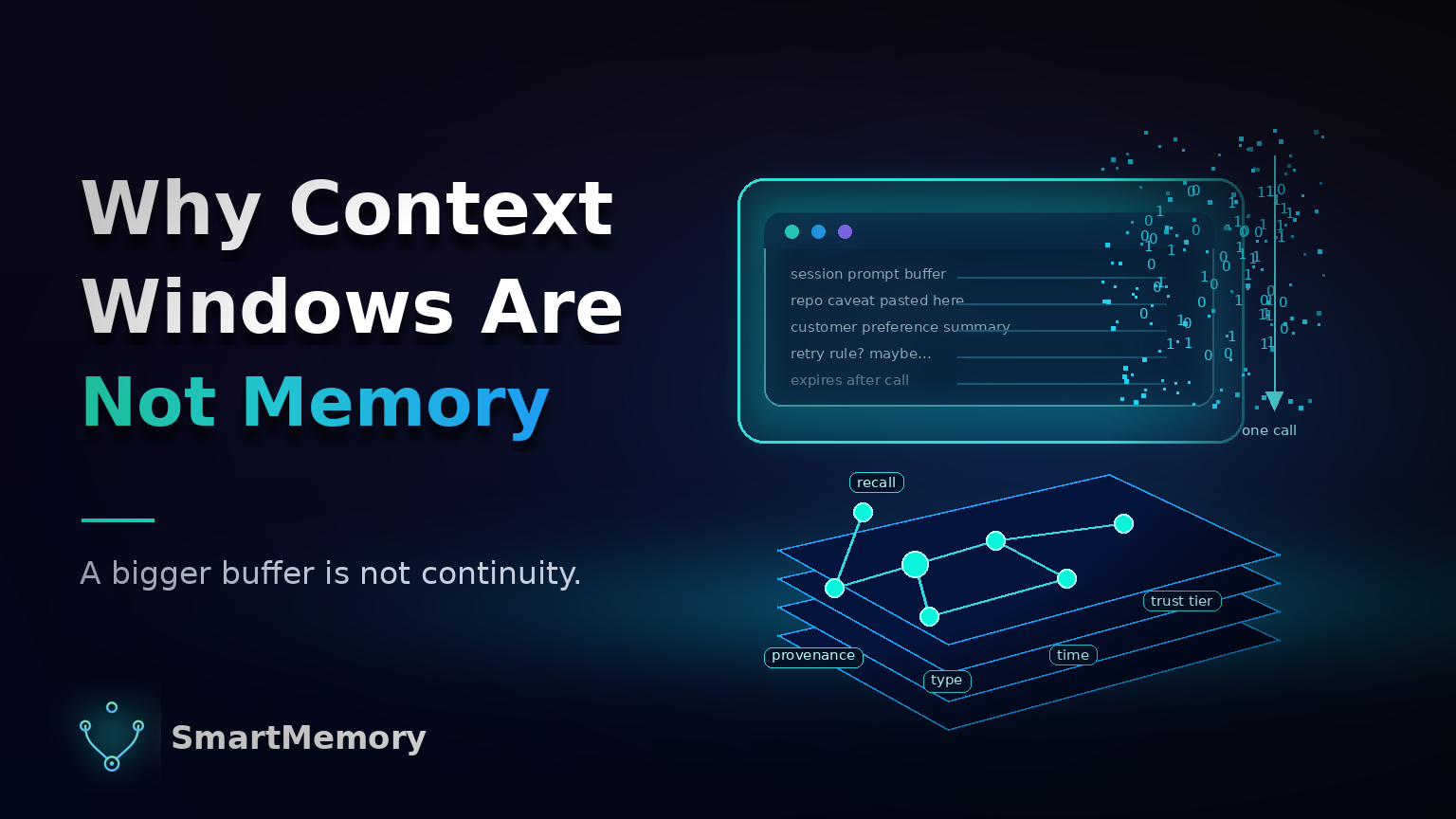
Why Context Windows Are Not Memory
A bigger context window is a roomier scratchpad, not memory. Durability and trust are a different problem.
A million tokens. Then two million. Every few months the number doubles, and every few months I watch a team read the announcement as proof that a hard problem just got solved. The model can finally remember. Your codebase. Your customer. The retry decision you argued about three weeks ago. The number going up feels like the wall coming down.
It isn't. A bigger context window buys you a roomier place to think for the length of one call, and then the call ends and the place is gone. That gap (between a buffer that's cleared at the end of the turn and state that's still there next Tuesday) is not a difference of degree you can close by making the buffer huge. It's a difference of kind, the same one that separates a local variable from a row in a database. One vanishes when the stack unwinds. The other survives the process, the deploy, the power outage, and shows up whether you wanted it to or not. We built SmartMemory (a memory infrastructure layer for AI agents) because almost every stack I've looked at conflates those two things, and that conflation is about to get expensive.
The window has no past tense
Start with what a context window actually is. The model rebuilds it from scratch on every call. You decide what goes in, it lasts exactly one turn, and it carries no authority beyond being the prompt. When the answer comes back, the slate is wiped. There is no "it" that recalls the last conversation. There's only the next prompt, which you assembled, which happened to include some text summarizing the last conversation. The model is stateless. It has always been stateless. Continuity inside a window is something you reconstruct by hand, request after request, and mistake for the model remembering.
Memory runs the other direction. It outlives the call instead of expiring with it. It grows instead of starting empty. And here's the part that matters: once a stored value is retrieved and acted on without being re-derived, it gets treated as true. That last move is the whole game. The moment you read something back and build on it instead of recomputing it, you've left computation and entered state, and state has a history, an owner, and a way to be wrong that sticks around.
Which is why the size of the window was never the interesting number. You can make it as large as you like. At the end of the session it's still empty.
Amnesia with a larger buffer
Here's the test I run on anything sold to me as memory. Restart the session. Close the tab, kill the process, come back tomorrow. What survived?
With a context window, nothing did. A two-million-token window forgets you completely the instant the session ends. The buffer is roomier. The amnesia is total.
Picture an onboarding assistant for a mid-size codebase. You open it Monday and spend an hour getting it up to speed: the module layout, the naming conventions, the one fragile migration that three call sites depend on, the reason the billing module imports from legacy/ and isn't allowed to stop. By lunch it's genuinely useful, answering as if it knows the system. Tuesday you open a fresh session and it knows none of it. So you do Monday again. You re-explain the layout, re-paste the migration caveat, re-justify the legacy/ import. Wednesday, the same. The assistant isn't learning your repo every morning. You are teaching it your repo every morning, and the only thing carrying knowledge from one day to the next is you. You're the database. You're the thing being read back as true, because nothing else in the loop persists.
The reason this is easy to miss is that within a single session the illusion holds. The window is big enough that you stop noticing how much re-establishing you do inside it, and you start mistaking "loaded in the buffer right now" for "known." Then the buffer clears and the difference comes back as a bill you pay every session, forever.
The thing you want is continuity
"Memory versus context" is too small a frame. What actually makes an agent feel like a colleague rather than a clever demo is continuity. The agent that talked to your customer yesterday should know it talked to your customer yesterday. The agent that picked up your retry convention on Monday should still hold it on Friday. Decisions stick, constraints carry, context compounds across sessions instead of resetting to zero at every boundary.
Continuity across sessions means persistence. There's no version of "remembers next week" that doesn't involve writing something down and reading it back later. And the instant you write something down to read it back later, you've built a memory system, whether you sat down to design one or grew one by accident. Most teams grow one by accident. You start with the window, hit the wall the first time a user says "like I told you last week," and bolt a vector store onto the side to shove the relevant slice back into the next prompt. That bolt-on is a memory system. Nobody reviewed its failure modes, because nobody admitted it was one.
Retrieval shows up the moment you want continuity
This is the step people keep trying to route around. You cannot pour everything you've ever known into the window, however large it gets, because "everything you've ever known" grows without bound and the window does not. A support agent that has handled ten thousand conversations can't carry ten thousand into the next call. So you select. You retrieve the relevant slice and put that in front of the model.
And the moment you retrieve, three questions exist that the window never had to face. The first is what do I pull back: that's relevance, and it's the one everyone fixates on. The other two are quieter. Is what I pulled back still true? And where did it come from? Did a person say it, or did a background process guess it? Those aren't retrieval-quality problems. They're trust problems, and a bigger window does nothing about them, because the window sits downstream of retrieval. Whatever you hand it, true or stale, asserted or inferred, gets pasted in and read back with the full authority of the prompt. The buffer has no opinion about whether what you wrote on it deserves to be believed.
So the question stops being "how much can the model hold?" and becomes: what survives the session, and can you trust it? Durability and trust are the two things a window structurally can't give you and a memory system has to.
Durable is the easy half
Let me make the trust half concrete, because durability is where most bolt-on memory stops and declares victory.
Take an agent with a vector store for memory. Over a week it accumulates notes. One, dropped in at 2 a.m. during an incident, reads: "auth check is being skipped on the internal endpoint for now." Another, written in a design review, reads: "every endpoint must validate the caller's workspace." Both persist. Both come back on a similarity search for auth on the internal endpoint. And there's the failure: the incident note and the design rule sit in one undifferentiated store, score about the same, land in the same prompt, and are read back with the same authority. The agent has no way to tell that one is a rule a human asserted on purpose and the other is a panic workaround someone scraped from a comment during a fire. Ask it to scaffold a new internal endpoint and it may reproduce the exception, faithfully, as the rule.
Nobody hallucinated. The memory was perfectly durable. It was also wrong to act on, and durability without trust just means you now persist your bad state instead of forgetting it. A buffer that loses the 2 a.m. note overnight is, in this one narrow case, safer than a store that keeps it and can't say where it came from. That's the line between a real memory system and a vector store with delusions of permanence. Persistence is table stakes. Making what survives trustworthy is the work.
What makes survival trustworthy
Once the goal is durable and trustworthy state, the requirements stop being mysterious. They're the ones you'd put on any system that reasons from stored data: provenance and type, joined at retrieval.
Provenance means every memory carries where it came from. Typed by a user? Pulled from an API? Or produced by a background process that compressed a few weak signals into a confident-sounding sentence? In SmartMemory each write gets an origin, and origins sort into visibility tiers so a speculative, derived memory doesn't get recalled with the authority of something a person actually said. The lowest tiers don't surface on a normal recall at all. (How that tiering is drawn and enforced is its own subject. I'll come back to it later in the series.) The 2 a.m. story is a provenance failure at root: a transient observation and a standing rule stored as the same kind of thing. Separate them and the workaround stays where it belongs: findable if you go looking, never quietly promoted into the next scaffold.
Type is the other half. A single blob can't hold the gap between a thing a user asserted in passing and a thing the system treats as settled fact, and that gap is the entire point. So memory is split into kinds rather than poured into one vector soup. Episodic memory is append-only testimony (the user said X at time T) and shouldn't graduate to a general fact on its own. Semantic memory is the challengeable fact layer. Procedural memory is how-to knowledge that has to be checked against the world it claims to describe. Pending is the unsorted inbox. Zettel is the linked, curated layer. Collapse those and you lose exactly the distinction the Friday scaffold needed. The window can't draw it either. On a scratchpad it's all just text. Typed, durable memory can.
Retrieval is where the two meet. recall asks for the relevant slice and gets back something filtered by trust tier and shaped by type: your decisions and constraints survive and surface, the 2 a.m. guesses don't get equal billing. That's the difference between state you rebuild by hand every morning and state you can lean on across sessions.
This is an expertise layer, not another memory system
Here's where this lands, and why we built it instead of chasing a bigger buffer.
A context window can hold what's true for one turn (the facts, the file, the last ten messages) and then it drops all of it. What an agent needs to stay useful over time isn't a larger tank for facts. It's the harder thing facts sit underneath: what to do, here, in this codebase, for this customer, given everything that came before and which of it you can still trust. That second thing only exists if it's durable, attributed, and accumulated. A window can't be it, however large it gets, because the window is rented for one call and this has to survive the call, carrying who asserted it and how long it held, along with it.
It's not a feature you bolt onto a model. It's the layer the model has been missing every morning it forgot your conventions and turned you back into the database.
So when someone shows you a bigger window and calls it memory, run the test: restart, ask what survived, ask whether you can trust it. If the answers are "nothing" and "no," you have a very large, very expensive buffer. The continuity is still coming out of your head. Closing that gap is a thing you build on purpose, and it's most of what the rest of this series is about.
I'm building SmartMemory, the expertise layer for AI agents: provenance-tagged, bi-temporal, graph-backed memory that knows not just what's true, but what to do, and when it stopped being true.
Try it: pip install smartmemory (docs) · hosted beta (private): smartmemory.ai/signup