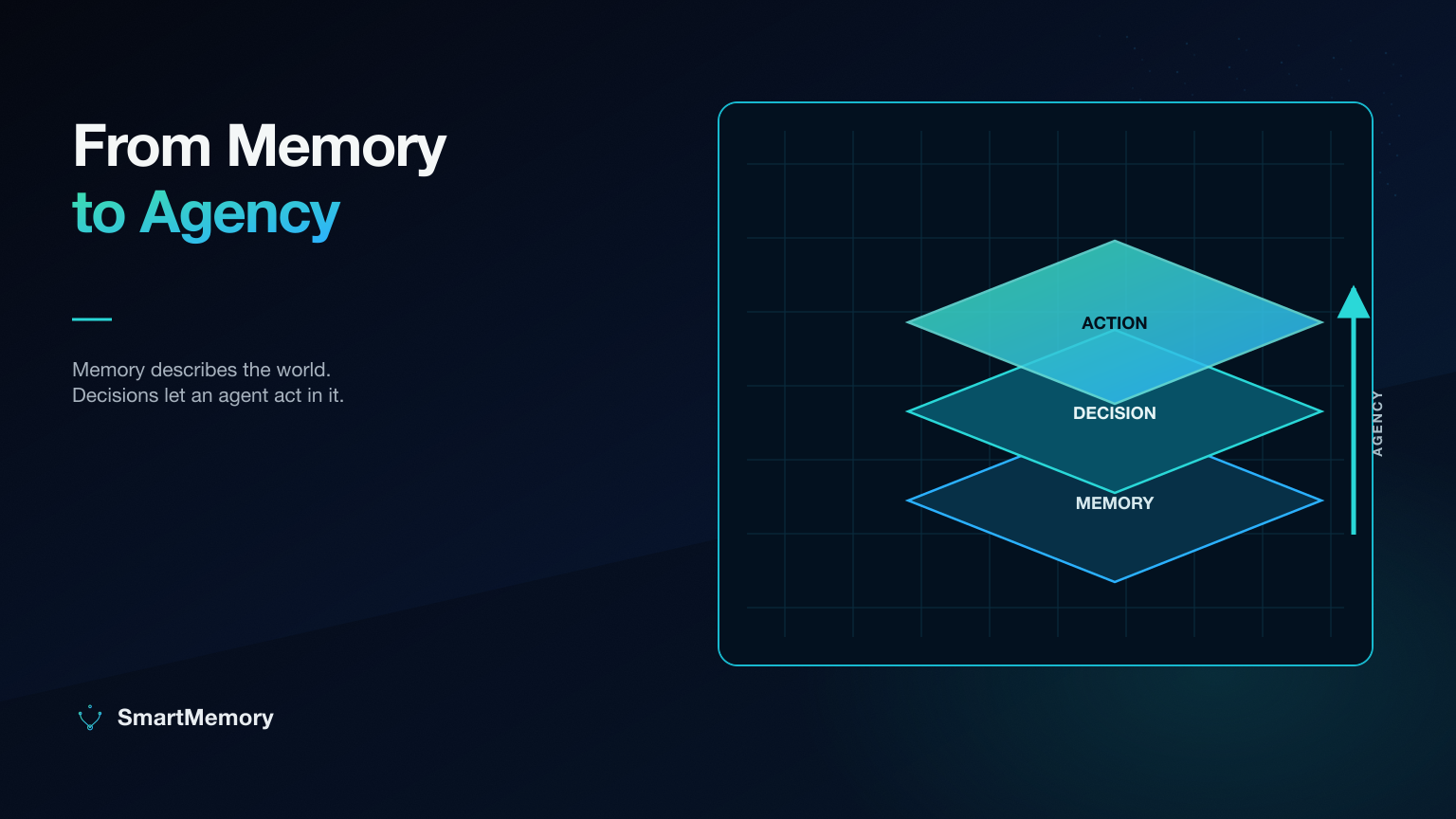
From Memory to Agency
Knowledge is what's true. Expertise is what to do. Decisions are where a memory system stops describing the world and starts committing to it.
I ended the main series with the line the whole argument had been driving toward: knowledge is what's true, and expertise is what to do. Then I came back with an essay about the memory agents write for themselves, and spent two more on a single type from that family, which might seem like a strange way to follow a finale. It is not. Decisions are the type that line was about. Two essays ago I argued a decision is not a fact: it is a commitment with a shape, and prose storage flattens the shape. Last week I walked through the lifecycle: decisions age by challenge, not by time, and the challenge history is the trust signal. This essay is the payoff, and the claim is simple to state. The decision record is where a memory system stops describing the world and starts participating in it. It is the object that turns memory into agency.
The two bad defaults
Strip decision memory out of an agent and it has exactly two ways to behave, both of which you have probably already watched happen.
The first is relitigation. Every session, every judgment call gets re-derived from scratch, from whatever partial context happens to be in the window. A model re-deriving a judgment call will not land in the same place every time, because judgment calls are exactly the questions with more than one defensible answer. Monday the agent shards by region. Thursday it shards by customer ID. Both defensible, and the disagreement between them is invisible to the agent because neither verdict was ever written down as a verdict. Users experience this as flakiness. It is not flakiness. It is amnesia about commitments, and no quantity of factual memory fixes it, because the missing state was never factual.
The second is the frozen prompt. The team notices the inconsistency and responds by hardcoding the judgment calls into the system prompt. Always use the EU cluster for European customers. Never retry the payments endpoint. Prefer streaming above this threshold. It works, at first, and it fails the way configuration always fails when it has no lifecycle. The prompt grows. Nobody remembers which lines are load-bearing. The reasons live in a pull-request description three quarters old. There is no way to record that one directive was contradicted by production twice this month, because a prompt has no place to put a contradiction. The frozen prompt is the Friday deploy freeze again, this time installed deliberately, at scale, in the one artifact every single call flows through.
Relitigate everything, or freeze everything. Fluid and inconsistent, or stable and unaccountable. What both defaults are missing is the same object: a store of commitments that persists (so no relitigation) and stays challengeable (so no freeze). That is decision memory, and there is no third place to put this state. It does not belong to the model, which is stateless by construction. It does not belong to the prompt, which cannot age. It belongs to the memory layer, as a first-class type with the lifecycle from last week attached.
Expertise is surviving decisions
In the finale I used the new-hire test: a new hire can read every document in the company and still be useless on day one, because documents encode what is true and almost none of what to do. It is worth pushing one level deeper, because the thing the experienced engineer has is nameable now.
What the senior person actually carries is a record of adjudicated commitments. Not more facts. The junior engineer can retrieve the same facts. The senior one knows what was tried and what was rejected, which rules are load-bearing and which are cargo cult, which past decision still holds, which one quietly expired, and which one failed so specifically that its failure is itself a guide. An expert, in other words, is someone whose rejected alternatives are still on file. That is what the ten thousand hours actually purchase: a decision history dense enough to navigate by.
This reframes what an agent memory system is for. A knowledge layer makes an agent informed. It answers what is true, and it commoditizes fast, because everyone's retrieval stack converges on the same corpus of true things. A decision record is different in kind. It is what your agent committed to, in your environment, against your constraints, including everything it tried that did not survive. Two agents with identical models and identical knowledge bases diverge the moment their decision histories diverge, and they never converge again. When I argued in the finale that accumulated state is the moat, this is the state I meant. The facts are copyable. The verdicts are not, because the verdicts were earned against your world.
The loop that compounds
Here is the mechanical version of "memory becomes agency," with all the pieces this arc has built.
Testimony arrives and is recorded as testimony. Facts are derived, challengeable, superseded when the world moves. On top of the facts, a decision is made: typed, linked to its evidence, born with lineage. The agent acts on the decision. And then the part that separates an expertise layer from a filing cabinet: the outcome comes back. The action produced a result, the result is evidence, and the evidence lands on the decision that caused it, as reinforcement or contradiction. The decision's standing changes. Contested decisions surface for review. Superseded premises trigger the inverse sweep from last week. The next decision is made against a record that now includes the fate of the last one.
That loop is the whole thesis of this series in one circuit. Memory that only flows forward (write, retrieve, act, forget) is a knowledge pipeline, and it never gets better at deciding, no matter how much it stores, because nothing about deciding ever flows back. Close the loop and the store starts accumulating the one thing that compounds: commitments annotated by their consequences. An agent with that record is not smarter than its model. It is more experienced than its model, which is a different property, and the only one that is genuinely yours.
Agency you can govern
There is a version of this argument that is about capability. The more useful version is about governance, because the question every team deploying agents actually faces is not "can it act autonomously" but "how much autonomy can we defend."
An agent's autonomy is bounded by its auditability. The reason teams keep humans in the loop is not that the model is dumb. It is that when something goes wrong, "why did the agent do that" has to be answerable, and in most stacks it is archaeology: scrolling session logs, reconstructing prompts, guessing at what the context window held. A decision record makes it a query. Which decision drove the action. What evidence the decision derived from. What was in force at that moment, under the bi-temporal record, as opposed to what is in force now. Whether the decision had already been contradicted and by what. That is the causal chain, and it exists because every link was written at creation time, not reconstructed after the incident.
Governance also runs in the other direction. Human intent enters the same store as decisions humans place: policies, with authority attached, challengeable like everything else but superseding on human terms. The agent's learned preferences and a team's explicit policies become the same kind of object, with different provenance and different weight, visible in one place. That shared record is the actual interface between human intent and agent autonomy. You delegate to the degree you can audit, and you can audit exactly what the store bothered to keep.
The arc, closed
Three essays, one object. A decision is not a fact: it is a commitment with a shape, and the shape (chosen, rejected, derived-from, who, what reopens it) is what storage must refuse to flatten. A decision ages by challenge: reinforced, contradicted, superseded, retracted, with ignorance and contest kept honest instead of laundered into one confident number. And a decision record closes the loop between acting and remembering, which is the property that turns a memory layer into an expertise layer, and an informed agent into an experienced one.
The industry will keep pouring effort into what agents know. The compounding advantage is in what your agent has decided, survived, and can account for. Knowledge is what's true. Expertise is what to do. And "what to do" is not a vibe the model emits fresh each session. It is a record. Build the record.
I'm building SmartMemory, the expertise layer for AI agents: provenance-tagged, bi-temporal, graph-backed memory that knows not just what's true, but what to do, and when it stopped being true.
Try it: pip install smartmemory (docs) · hosted beta (private): smartmemory.ai/signup