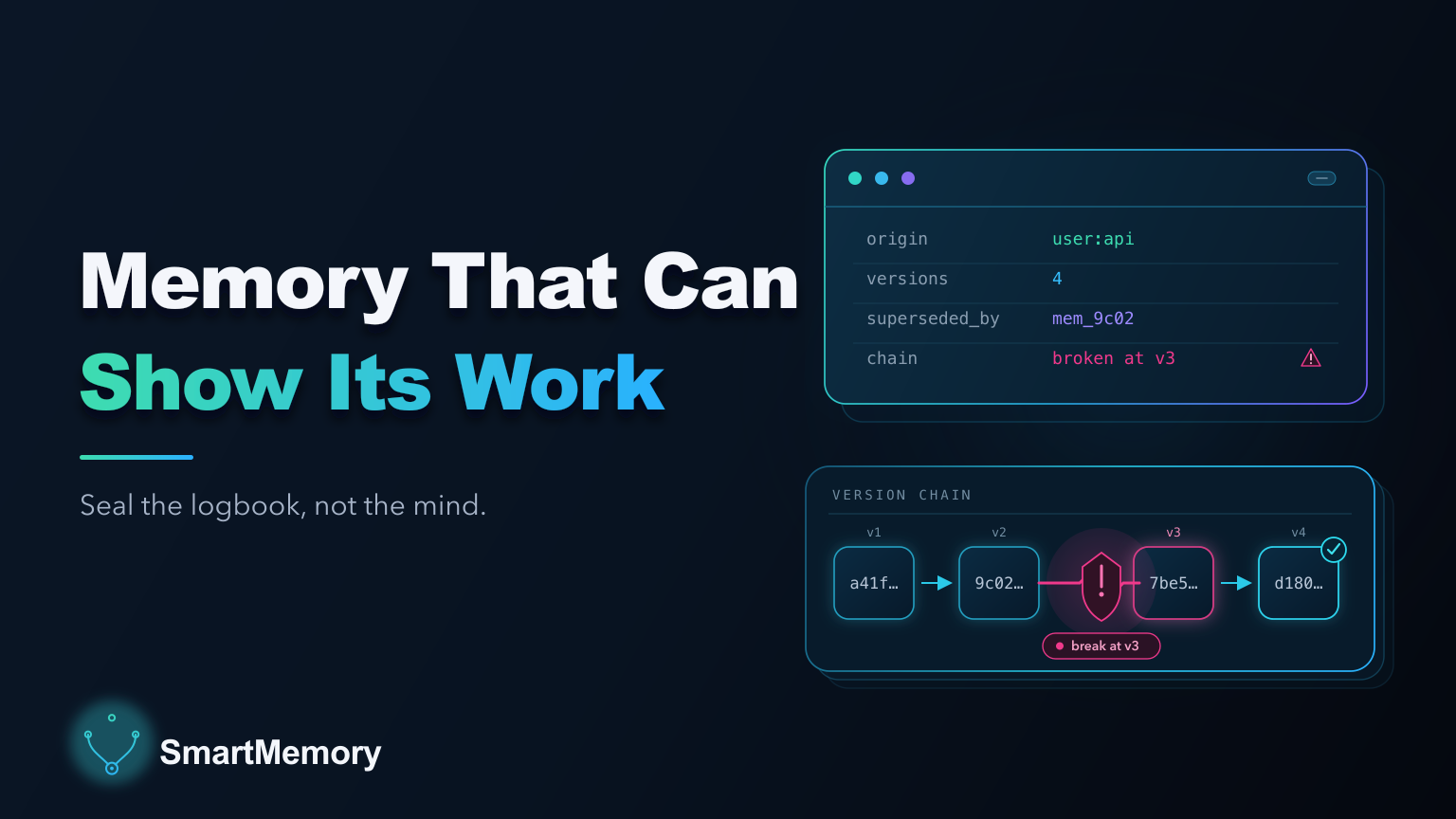
Memory That Can Show Its Work
Agents are starting to get asked the question humans get asked: how do you know that? We just shipped the machinery that lets a memory answer with lineage instead of vibes, and the design argument underneath it is that you seal the logbook, not the mind.
TL;DR. The question that kills trust in an agent is not "what do you know" but "how do you know that." Most memory systems cannot answer it, because they keep one version of the truth and quietly overwrite the rest. We just shipped auditable memory in SmartMemory: a memory can account for itself in one call (where it came from, how it changed, what replaced what), the versions it keeps from here on are chained into a tamper-evident history, and search takes an as-of date that resolves results to what they said then and labels the ones it cannot resolve. The design argument underneath is the part I care most about. You do not need to freeze a memory store to prove its history, because plasticity is a property of the current state and proof is a property of the record behind it. Seal the logbook, not the mind. The last third of this post is what the feature does not prove, and what it still cannot do, because an audit feature that oversells itself is worse than none.
There is a moment coming for every team that puts an agent in front of real work, and I have started thinking of it as the deposition moment. Something goes wrong, or something goes weirdly right, and a human asks the agent's operator a very human question: how did it know that? Why did it believe the billing service had its own Redis? Who told it the customer had churned? When did it decide the migration was done?
Today, for most agent memory systems, the honest answer is a shrug. The store retrieved something with a high similarity score. The something came from somewhere. It may have been edited since, by a background job or a well-meaning write, and whatever it said before the edit is gone. The system reports what it believes now and assumes it always believed it. I wrote about this failure in the time essay: a store that keeps exactly one version of the truth has no way to show its work. That essay argued that memory needs history. This one is about the thing we just shipped, which is the other half: making the history something you can actually trust.
From "here's what I retrieved" to "here's how I know"
The feature is called explain, and the shape of it matters more than the name. You hand SmartMemory a memory id and you get back, in one call, an account of that memory: where it entered the system (a user said it, an API wrote it, a background process derived it), each version it has been through with the reason recorded for that change, a content hash where one exists, and a preview of the content, the supersession chain of what this memory replaced and what replaced it, the lineage pointing back to the items it was extracted from, the decisions that cite it, and a verdict on whether the hashed part of that history still checks out cryptographically.
That last clause is the new muscle. Storing a version history is easy. Making the history mean anything is not, because a history that can be silently rewritten is just a second place to lie. So every version written since the feature landed carries a content hash chained to its predecessor's, the same construction that makes a git history tamper-evident. Recompute the chain and compare: if anyone edited version three after the fact, the verifier tells you the chain broke, where it broke, and which kind of break it was, rather than showing you a red light and wishing you luck.
There is a second layer above the per-memory chains. The system can take a fingerprint of a workspace, a Merkle root built over the current chain heads it can actually attest to, and anchor that fingerprint outside itself through a public timestamping service. Two things about that layer are easy to misread. It is not a photograph of everything you own: the sweep covers committed, hashed chain heads, which leaves out in-flight writes, memories predating the chain, and memory types that carry no version chain at all. It is also not an instant. The sweep runs over a window and records when it started, and that start time is the edge of what it covers. Meanwhile the per-memory chains are on by default wherever a memory keeps versions at all, while checkpoint generation and witnessing ship switched off, and the endpoint that reads them is Enterprise-tier. The endpoint itself is always there, which matters because what it tells you depends on who is asking. On our hosted service a non-Enterprise account does not get a verdict at all, it gets a billing gate. A self-hosted deployment has no billing boundary to enforce, so it reaches the verifier and gets a real answer, which on a default install is that there is no checkpoint to check against, since nothing has been switched on to generate one. Worth noting that the absence itself is ambiguous by design, because a missing checkpoint looks the same whether the sweep never ran or somebody deleted it, and the response says so rather than guessing. For most people reading this, in other words, the working audit surface is explain plus as-of recall.
The search side got the matching capability. You can now ask any query as of a date. Each result whose history resolves comes back as the version that was current then, anything that did not exist yet drops out of the set, and every result that does come back declares which of those happened to it. Hold onto that qualifier, because I come back to it later and it is the least comfortable sentence in this post. Superseded versions ride along in an as-of query whether or not you ask for them. The mechanism matters here: retrieval still runs against today's index, and the as-of resolution is applied to the results that come back. So you get the content the store held on June 1st, not a reconstruction of the ranking it would have produced on June 1st. An item that mattered under its old wording may never enter the candidate set at all. Combined with explain, though, the deposition moment still changes character. "What did the agent believe when it acted, where did that belief come from, and has the record been edited since" stops being archaeology against backups and becomes a few API calls.
Seal the logbook, not the mind
Now the design argument, because this is where I think most of the industry will get it wrong, and where we almost got it wrong ourselves.
When you say "tamper-evident memory" out loud, the instinct is to reach for immutability and apply it to the wrong object. Make the memory itself append-only. Nothing can ever be edited, therefore nothing can ever be falsified. That equation fails, because a memory store is supposed to change its mind. Consolidation rewrites episodic fragments into semantic summaries. Decay demotes stale facts. Supersession retires beliefs that stopped being true. Opinion synthesis merges contradictions into positions. Freeze the store to protect the evidence and you have built something that can never forget its worst data and never revise its best guess. You have preserved the evidence by lobotomizing the witness.
Now, a working engineer will already be objecting, and the objection is correct: this is a solved problem and it is called event sourcing. An append-only log of events plus a mutable projection over them gives you exactly the separation I am describing. Corrections, supersessions, consolidations, and confidence changes are all just more events, and the current view is free to move. So let me concede the point and sharpen the claim, because the concession is the interesting part. I am not arguing against ledgers. I am arguing that memory systems should adopt the log-versus-projection split that ledgers and event-sourced systems settled decades ago, and that most of them have not. What you find in this category instead is a mutable store with no durable log underneath it, where the "current view" is the only artifact and every revision destroys its own predecessor. The instinct that gets reached for is not event sourcing, it is freezing the projection, and freezing the projection is what kills learning.
So the thing to protect is not the current state. It is the account of how you got there. Let the memory rewrite itself all day long, because that is its job, while every rewrite lands in a logbook whose entries chain into each other so they cannot be quietly reordered or reworded, and the logbook's fingerprint gets lodged somewhere the author cannot reach. The mind stays plastic. The record of the mind's changes goes rigid. Proof and plasticity stop being a trade-off because they were never about the same object.
The distinction shows up everywhere once you have it. Your bank account balance changes constantly while the transaction log does not. A scientist's beliefs evolve, but the lab notebook is ink. Git will happily let you rewrite a file a thousand times while refusing to quietly pretend the previous commits said something else, though that last one deserves an asterisk I will collect on later, because a local repository will absolutely let you rewrite its history with a rebase and a force push, and the reason anyone notices is that someone else already has a copy. In every case the trusted artifact is the sealed trail, not the current value. Memory systems for agents should have been built this way from the start, and mostly they were not, because the first generation of them grew out of retrieval demos where the only question was "is this relevant," never "is this still true," and never, ever "prove it."
What this does not prove
A hash chain proves that the recorded history it covers has not been rewritten. It does not prove the history was true when it was written. If someone feeds the agent a lie on Tuesday, the chain will faithfully and verifiably preserve the lie, and explain will show you when the lie arrived and the recorded steps it went through afterward, which is genuinely useful for tracing damage. But tamper-evidence is provenance, not truth.
Second, this is history integrity rather than per-transaction signing. The chain proves the sequence of versions is intact. It carries no cryptographic signature from the author of each write, so it cannot tell you who wrote a given version the way a signed commit would. Origin is recorded and audited, and recorded is a weaker word than signed.
Third, and this one bites on day one: the chain only covers what it was there for. Version rows written before the feature shipped carry no hashes, so a memory that was already being revised back then has an unhashed prefix, and a positive verdict means the hashed suffix recomputed cleanly, never that the older part did. The verifier reports how many legacy versions sit in front of the coverage boundary for exactly this reason. A green check over the last two versions of a forty-version history is a much smaller claim than it looks, and any interface that shows the verdict without the coverage count is lying by omission. Some memory types carry no version chain at all, and for those the verdict is a null that means "nothing to check here," which must never be rendered as a tamper warning.
Fourth, and this is the one a hostile reader should push hardest on, because integrity of a record is not the same as sufficiency of a record. Suppose an episodic memory gets consolidated into a semantic summary. The chain proves the summary's own history is intact. It says nothing about whether the summary faithfully represented what it consumed. That gap is survivable while the source is still there, and our decay path is careful here, since decay marks a memory archived rather than destroying its content. Delete the source outright, though, and what survives is thinner than it looks. The graph edge goes with the deleted node, while the consolidation still carries its source ids in metadata, and the lineage walker still reads them. So the summary can name its ancestor and cannot produce it. An identifier you can no longer dereference tells you that evidence once existed. It is not the evidence. A Merkle root is a commitment to content, not a copy of it, so it cannot bring back what a checkpoint once covered, and the workspace verifier can only flag a memory as missing if that memory was in the manifest to begin with. Auditability therefore depends on retention. Throw away the evidence and a perfect chain proves only that you have not tampered with what remains.
Fifth, an edge that was open when I started writing this. If an as-of query could not resolve a particular memory's history, the system kept that result at its present-day state and logged a warning nobody outside the server would ever see. Someone asking what the store believed in June could receive a piece of today, unmarked. Our own contract had flagged it, rated it high severity, and said it should have been settled before the as-of parameters went public. It listed three ways out. Nobody picked one and the parameters shipped anyway.
That is settled now. Every result of an as-of query carries a resolution label, so present-day content standing in for a historical belief has to say so, and the response carries a count of how many such results it contains. If you would rather have no answer than a partial one, you can ask for the whole request to fail instead. Two coarser failures, a date that will not parse and a version resolver that is unavailable, now refuse outright rather than quietly returning an ordinary present-day search wearing the shape of a historical one. The residue I cannot talk you out of is the count itself. Zero unresolved results means nothing returned to you was labelled unresolved. It does not certify the query, because a result dropped for being unreconstructable never reaches the page to be counted.
Last, this is where I collect on the git asterisk: a private chain alone cannot defend against its own operator. Whoever controls the store could delete the whole history and recompute a clean-looking chain from scratch, exactly the way a force push rewrites a local repository, and every hash would verify. No implementation escapes that, ours included, because it falls out of what a self-contained system is. Any vendor telling you their internal audit log alone is operator-proof is selling you something. What saves git is not the hashing. It is that someone else has a copy. The only exit is to lodge the fingerprint somewhere outside, which is the entire point of the external witness.
That brings me to what actually ships, and it changed while I was writing. The submission and confirmation half was already built: checkpoints go out to a public timestamping service and a worker follows them until they are confirmed. The last mile, validating a returned proof back against the checkpoint root inside the verifier, was not wired, so the endpoint declined to claim the witnessed tier at all and reported the weaker local-only tier even for a confirmed proof. It is wired now. Ask about a checkpoint that carries a proof and the verifier checks that the proof commits to that exact root and workspace, so a real proof cannot be swapped in from another document or lifted off another workspace. Since nothing on our hosted service generates checkpoints yet, that is a path you can run rather than one an ordinary hosted request goes down today.
The verifier also checks that the Bitcoin block behind the proof hashes to what its source claimed, that it carries genuine proof of work, and that it clears a difficulty floor. I first wrote that those checks meant the header could come from a public explorer we do not trust. That was wrong. They put the price of a forged header at roughly two days of a thousand-machine mining farm, which sounds like a wall until you measure it against the thing it is imitating, where it is about forty seconds of the real Bitcoin network. That floor prices out a casual forger and nobody with actual hashrate. It buys cost, not proof, and a header on its own still says nothing about where it sits in history, so it does not establish that the header came from the real Bitcoin chain. Point us at your own Bitcoin node and we stop relying on public explorers for chain identity. Use the public fallback and you are trusting those sources, with the small consolation that we require two separate public domains to agree first.
Three limits remain. First, the anchor time you are shown comes from the Bitcoin block rather than from a field in our own database, because a field in our own database is written by the same system that would be doing the rewriting, though a block time is picked by a miner and is only ever a coarse bound. The stored timestamp is still in the response, marked informational, and it is not what the verdict rests on. Second, an anchor attests to a checkpoint at a moment, so everything written after the most recent anchored checkpoint sits outside the witnessed window and falls back to the internal chain. Third, there is a rollback an anchor cannot fix on its own. Restore the store to an older checkpoint that genuinely was witnessed, drop everything after it, and verification answers witnessed, because nothing in what remains is fake. It is only old. The exit there is for someone outside to remember the newest fingerprint, which is a different piece of work than this one.
When no header source is reachable at all, the answer stays local-only and says why, since an outage is not evidence of tampering.
So, the claim boundary. SmartMemory shows you where a recorded belief came from and whether the version history it kept still verifies. It does not prove that belief was true, and it does not authenticate who wrote it. It covers your older memories only from the day the chain reached them, and it cannot vouch for evidence you deleted. External anchors do now validate. In public-explorer mode that validation still leans on outside sources for the truth about the Bitcoin chain, it reaches only as far as the last anchored checkpoint, and it does not by itself catch a rollback to an older witnessed state.
What changes when agents start acting
There is a compliance story here, and I want to be careful with it, because "auditable" is a word that gets stretched. As-of queries and a verifiable version history are useful audit infrastructure. They are not an audit programme. A real one also wants authenticated authorship, authorization evidence, completeness and retention guarantees, access logs, and exportability, and I just spent a section conceding that we do not have several of those. Useful infrastructure is the size of the claim.
The reason this exists is that agents are starting to act, and action changes the stakes of memory. A chatbot that misremembers wastes your afternoon. An agent that misremembers restarts the wrong service, emails the wrong customer, or trades on a constraint that was lifted last quarter. The postmortem for that incident runs straight through the memory system, and a memory system that cannot reconstruct what it believed at 03:14, or show whether that reconstruction has been edited since, turns every postmortem into "root cause unknown, state not recoverable." That is the worst line you can write in an incident review, because it is an admission that the system cannot account for itself.
There is a quieter reason too. Memory that can show its work changes how much work you are willing to hand over in the first place. Trust in an agent is less a feeling about the model than a bet about whether you could find out what happened afterward. Systems that can be interrogated get given responsibility, and systems that shrug get supervised forever.
I will finish with how two errors got into this post, because it is the argument for the whole feature playing out on the feature itself. I did not write them from memory. They came out of an independent fact-check of this draft against the shipped source, run because a claim on our own domain has to survive someone checking it. One was a genuine surprise: the external anchor's final validation step was stubbed, so the strong tier could not be claimed at all. The other was worse than a surprise, because it was already written down. The as-of gap sat in our own contract, marked high severity, marked as something to settle before those parameters went public, and the parameters went public regardless. Nobody had lied about either one. They had simply stopped being read.
Both changed while I was writing, which is the least interesting part of this. What matters is where they were found. Not by writing the code and not by reviewing it. They were found by writing a public sentence and then checking it against the record.
That is the failure mode this whole feature exists to attack, and it is not really a technical one. A record that nothing forces you to reread might as well not exist. Making a system show its work is how you find the places where it is thin, and the uncomfortable part is that the conclusions sound identical either way right up until somebody checks.