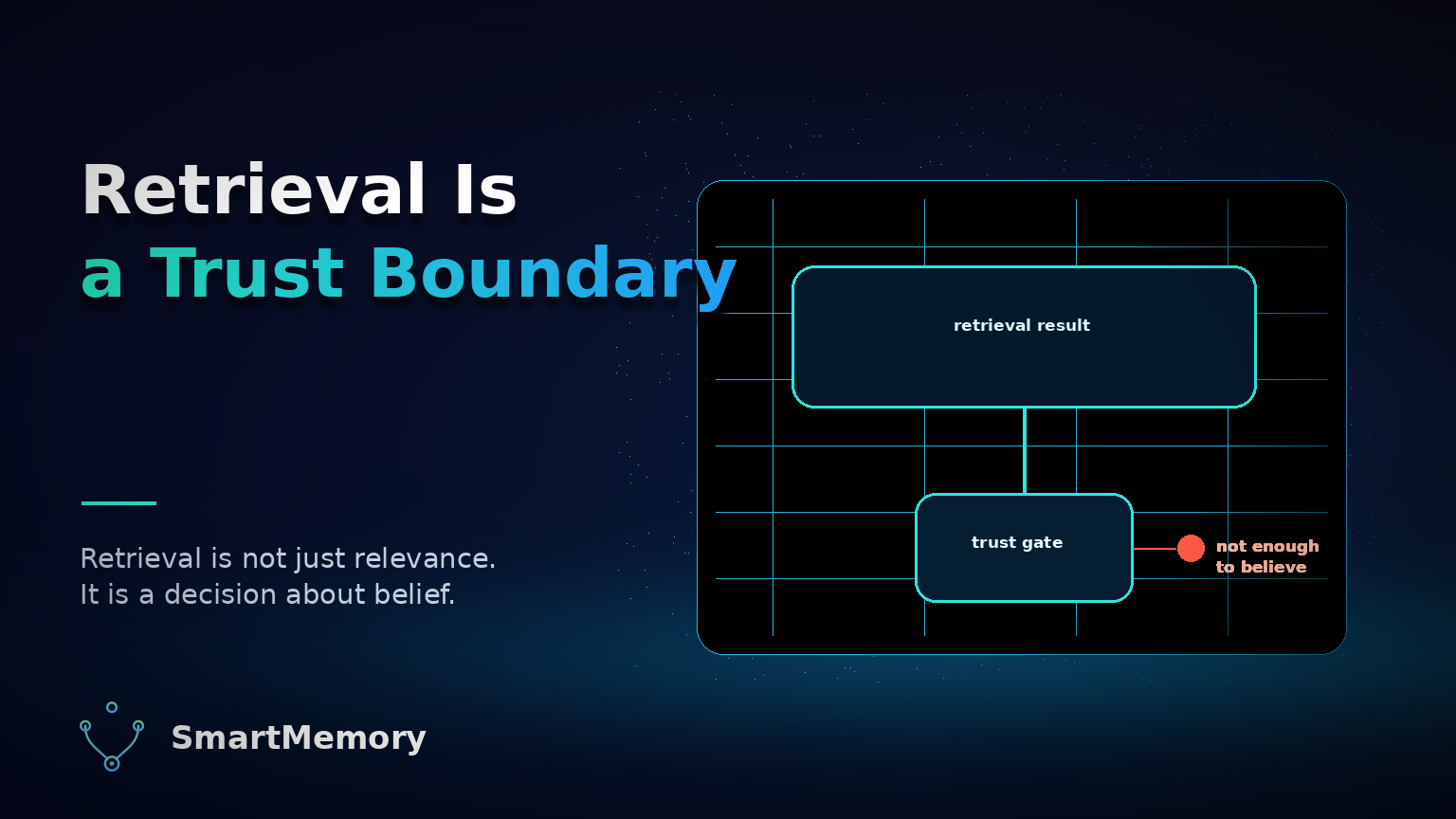
Retrieval Is a Trust Boundary
Retrieval's real question is not 'is this relevant?' but 'should I believe it?' Make that decision explicit.
Start with a failure that sounds impossible: an agent confidently quotes a "fact" back to you that no human ever said. It isn't a hallucination in the usual sense. The agent retrieved it cleanly (top result, high score) from its own memory store. Somewhere upstream, a background job guessed at something, wrote the guess down, and then the retrieval layer handed that guess to the agent with exactly the same ceremony it would have given a line a senior engineer typed by hand. The agent didn't invent anything. It trusted something it shouldn't have, and nothing in the pipeline gave it a way to tell the difference.
That failure mode is what made retrieval stop looking like a search problem to me. For a long time I treated it as one: find the closest match, rank it, hand it back, obsess over precision and recall. None of that is wrong. It's just answering the wrong question first. The most important question a retrieval system asks is not "is this relevant?" It is "should I believe it?" And almost no system I've looked at asks that one out loud. They answer it anyway. They have to, every single time they return a result. But they answer it implicitly, with a number that was never meant to carry that weight. I think this is the quiet design flaw at the center of most agent memory today, and I want to walk through why I now believe retrieval is not a search boundary at all. It's a trust boundary.
The number we asked to do too much
Here is the thing a similarity score actually tells you: this text is near that text in some vector space. That's it. It is a statement about geometry. It says nothing about whether the retrieved statement is true, whether it's still true, who said it, or whether the system had any business treating it as authoritative.
But watch what happens in a typical RAG or agent-memory pipeline. You embed the query, you pull the top-k by cosine similarity, you drop those chunks into the prompt, and the model treats every one of them as context, as something to reason from. The relevance score did one job: ordering. Then the architecture silently promoted it to a second job it was never qualified for: deciding what the model is allowed to believe.
A high cosine similarity to a sentence a user typed yesterday and a high cosine similarity to a sentence a background summarization job invented at 3 a.m. land in the same place in the top-k. The model can't tell them apart, because by the time the text reaches the prompt, the only thing that survived the trip is the text. The provenance (who wrote this, how, and how much we should trust it) evaporated somewhere between storage and retrieval, and nobody noticed because the pipeline never had a place to put it.
That is the implicit trust decision. Every retrieval system makes one on every result. Most don't know they're doing it. They hand the model a guess and a fact with identical authority and call it relevance.
Relevance and credibility are different axes
It took me an embarrassingly long time to see that these are two orthogonal properties, because in classic search they're so often correlated that you can pretend they're the same thing. A document in your search index is a document. They're all roughly the same kind of object, all roughly equally "real." Credibility is roughly constant across the corpus, so ranking by relevance alone is fine.
Agent memory breaks that assumption hard, because an agent's memory store is not a corpus of documents. It is a heterogeneous pile of claims of wildly different epistemic status, all living in the same index:
- A constraint a user explicitly typed: "never auto-deploy to prod on Fridays."
- A fact ingested from an API call with a real source behind it.
- A conclusion an evolver derived overnight by compressing a dozen episodic observations into one semantic generalization.
- An opinion a background process inferred from thin behavioral signal: "the user seems to prefer terse responses."
- An enrichment some enricher tacked on, a sentiment label, a topic guess.
Every one of those can score high on relevance for the same query. They are about the right thing. But they are not equally believable, and the gap between "the user said this" and "a background process guessed this from a faint signal" is enormous. A retrieval layer that ranks them on similarity alone is telling the model: these are the same kind of thing. Act on whichever one is geometrically closest.
That is how you get an agent confidently asserting a derived guess as though a human had stated it. And here's the uncomfortable part: the model is doing its job. It read its memory and repeated it with the authority that memory carried, which was indistinguishable from any other. The mistake was made one layer down, when retrieval handed over a guess dressed in the exact same packaging as a fact and kept no record of which was which. Call it what it is. The retrieval layer launders a guess into a fact by stripping the only signal that would have let anyone tell them apart.
A scenario, to make it concrete
Picture a coding agent that has been working in a repo for a few months. Someone asks it, "what's our policy on retries for the payments client?"
Retrieval fires. Top result, high score: a sentence that reads "the payments client retries idempotently with exponential backoff." Relevant. Unmistakably about the right thing. The agent writes code against it.
Now: where did that sentence come from? In a similarity-only store there is no answer to that question at retrieval time, because the question wasn't preserved. It could be a line a senior engineer wrote in a design doc you ingested, in which case, great, believe it. Or it could be a generalization a background evolver produced by noticing the word "retry" near the word "payments" across a few unrelated conversations, and compressing that coincidence into a confident-sounding semantic claim. The retrieval layer can't tell those two apart. They score the same and sort the same. The agent ships idempotent-retry code on top of a payments client that, in reality, is not idempotent at all, and now you have double charges in production traceable to a memory that was never anything more than a plausible guess.
Nothing was invented. The model used what it was given. The failure was that retrieval treated "an engineer asserted this" and "a process inferred this" as interchangeable, because the only thing it knew how to compare was the vector.
Walk through how the debugging of exactly this goes. The store returns a result you're sure is a hallucination: a confident claim that doesn't match anything you remember putting in. It has the top score. On relevance it's perfect. Everything in the retrieval logs looks healthy. So you go the other way and query the store for the record itself, expecting to find a user-authored line. What you find is a derived item a consolidation pass wrote overnight, stitched together from two unrelated conversations that happened to share a couple of nouns. The retrieval was working flawlessly. That's the unsettling part. Nothing is broken in the part of the system you're staring at. The answer is just landing on something it had no business trusting, and the layer that returned it has no opinion about that at all. This is why I will kill a design that scores better on retrieval quality if it has no way to refuse to act on a result like that one. A higher score on the wrong axis is not an improvement.
Make the trust decision explicit
The fix is not a better embedding model. A better embedding model gives you a more relevant guess. It does nothing about believability, because believability was never in the vector to begin with. The fix is to stop letting the trust decision happen by accident and force it into the open. Three things have to be true.
First, every memory has to carry where it came from. In SmartMemory every memory item has a first-class origin field. Not a stray piece of metadata, but a structural property of the record. The write path sets it automatically. Something a user typed through the CLI carries a cli: origin. Something ingested through the API carries api:. Something an evolver derived by promoting an episodic observation into a semantic fact carries an evolver: origin that names exactly which evolver and which transformation produced it. The provenance is not reconstructed after the fact or guessed from heuristics. It is stamped at write time, by the only code that actually knows the truth of where the memory came from: the code doing the writing. This is the same instinct from the system that taught me the most: instrument the write path, because the write path is the one place that still knows the truth. Everything downstream is working from a copy.
Second, origins sort into visibility tiers, so credibility becomes a property of retrieval rather than an afterthought. SmartMemory groups origins into tiers by how much authority they've earned. User-authored content (the things a human actually typed or imported) sits at the top. Evolved content that graduated through a real promotion path sits below it but still fully trusted. Speculative derived content (opinions, observations, enrichments, the conclusions a background process inferred from thin signal) sits in a lower tier, present and useful but explicitly marked as less authoritative. System bookkeeping sits lower still, hidden by default. The tier isn't a confidence score the model squints at and ignores. It governs what retrieval is even willing to surface as authoritative, before the model ever sees a token.
Third, and this is the part I'm proudest of: recall and search have different visibility. This is the move that turns the whole thing from a labeling exercise into an actual trust boundary.
Recall is not search
Recall and search look like the same operation. They are not, and conflating them is most of the problem.
When an agent recalls, when it pulls memory to reason from, to act on, to treat as the working truth of the situation, it should see only what's trustworthy enough to act on. So recall surfaces the authoritative tiers: user content and graduated, promoted knowledge. It deliberately does not surface the speculative derived tier. A background process's guess is simply not in the set of things the agent gets to act on as though they were true. It was never recalled with authority, so it can't quietly steer a decision.
When you search, when you're exploring, when you want to know everything the system has touched on a topic, including the soft, derived, speculative material, you get a wider view. Search includes the speculative tier. The guesses are findable. They are not lost. They're useful for exploration, for surfacing weak signal, for "what does the system think it knows here." They are just not handed to the agent as ground truth.
A speculative derived memory is searchable but not recalled with authority. It exists, you can find it, you can inspect it, it can inform exploration. But it does not get to walk into a decision wearing a fact's authority. The agent that asks "what should I do here?" sees the trustworthy set. The operator who asks "what has the system inferred?" sees everything. Those are different questions, they deserve different answers, and almost every memory system I've looked at answers both with one undifferentiated top-k.
And when you need finer control than the default tiers give you, the trust decision is a parameter you hold directly. You can filter retrieval to a specific origin: show me only what came from users, exclude anything an enricher touched. Retrieval stops being a single similarity ranking and becomes a graded decision you can actually reason about and tune. Not just what's near this query, but what am I willing to believe, for this purpose, right now.
Why this is the heart of the expertise layer
Here's the distinction I keep coming back to, because it organizes everything we build. Storing and retrieving facts is the easy half, and the half the industry has mostly solved. The hard half, the half that's actually worth building a company around, is knowing what to act on. And you cannot know what to act on if you can't tell a verified human statement from a 3 a.m. machine guess.
That second thing, the judgment of which retrievable claims are trustworthy enough to act on, is what we mean when we say expertise. A senior engineer's value is not that they can recall more facts than a junior. Search gives everyone the same recall. Their value is that they know which of the things they could retrieve actually deserve to drive a decision, and which are folklore, stale, or somebody's untested hunch. That's exactly the discrimination an origin-tiered, recall-versus-search retrieval layer encodes: the system declines to act on what it hasn't verified, while still letting you go look at everything it knows.
A flat, similarity-only store cannot represent that distinction, because it flattened it at write time. It kept the text and threw away the epistemics. A vector index on its own is geometry. The moment credibility matters you have to pair it with something that carries provenance: metadata filters, ACLs, an origin field. Most stacks that do pair them still leave that second dimension as inert metadata nobody ranks on. You can bolt a reranker on top, you can tune your thresholds, you can buy a better embedding model, and you will still be answering "is this relevant?" with great precision while the question that actually determines whether your agent is safe to deploy, "should I believe it?", goes unasked.
What to do if you're building on retrieval now
If you are wiring this up, start here:
- Separate relevance from credibility, explicitly. They are different axes. The moment you find yourself using a similarity score to decide what to trust rather than what to order, you've overloaded a number that can't carry that weight. Add a second dimension.
- Stamp provenance at write time, on the write path. Not reconstructed later, not inferred from heuristics. The writer is the only component that knows the truth of where a memory came from. Capture it there or lose it forever.
- Tier your origins by earned authority. A user statement and a background inference are not the same kind of object. Make the difference structural, not advisory: something retrieval enforces, not something the model is politely asked to consider.
- Make recall and search different operations with different visibility. Acting-on and exploring-around are different questions. Let speculative material be findable without letting it be acted on as truth. If your "recall" and your "search" return the same set, you haven't drawn a trust boundary at all. You've just renamed the same query twice.
- Treat retrieval as a place where authority changes hands. That is the definition of a trust boundary, and we've spent decades learning to put controls exactly there in every other kind of system. A memory store an agent reasons from is no different.
The leverage isn't in the ranking function. It's in the trust decision underneath it, the one your system is already making on every single result whether or not it admits to making it. Every result your retrieval layer returns is an answer to "should I believe this?" Delivered silently, in a number that was only ever meant to mean "this is close." The whole argument of this essay is that you should stop letting that answer be implicit.
So drag the decision into the open. The cleanest way I know to think about it is two questions an agent never gets to ask itself, because the retrieval layer answers them first: what am I allowed to believe, and what am I only allowed to find? A verified human statement and a 3 a.m. machine guess can be equally findable and must not be equally believable, and that line is not something the model can draw from the inside. By the time a claim reaches the prompt, the evidence for drawing it is already gone. So you draw it one layer down, on purpose, at the moment the claim is handed over. Retrieval isn't search. It's the point where a stored claim is granted, or denied, the authority to change what your agent does next. Decide, deliberately, what your agent is allowed to believe. Treat retrieval like the boundary it is, and build the controls there.
I'm building SmartMemory, the expertise layer for AI agents: provenance-tagged, bi-temporal, graph-backed memory that knows not just what's true, but what to do, and when it stopped being true.
Try it: pip install smartmemory (docs) · hosted beta (private): smartmemory.ai/signup