Why Everything Becomes a Graph Eventually
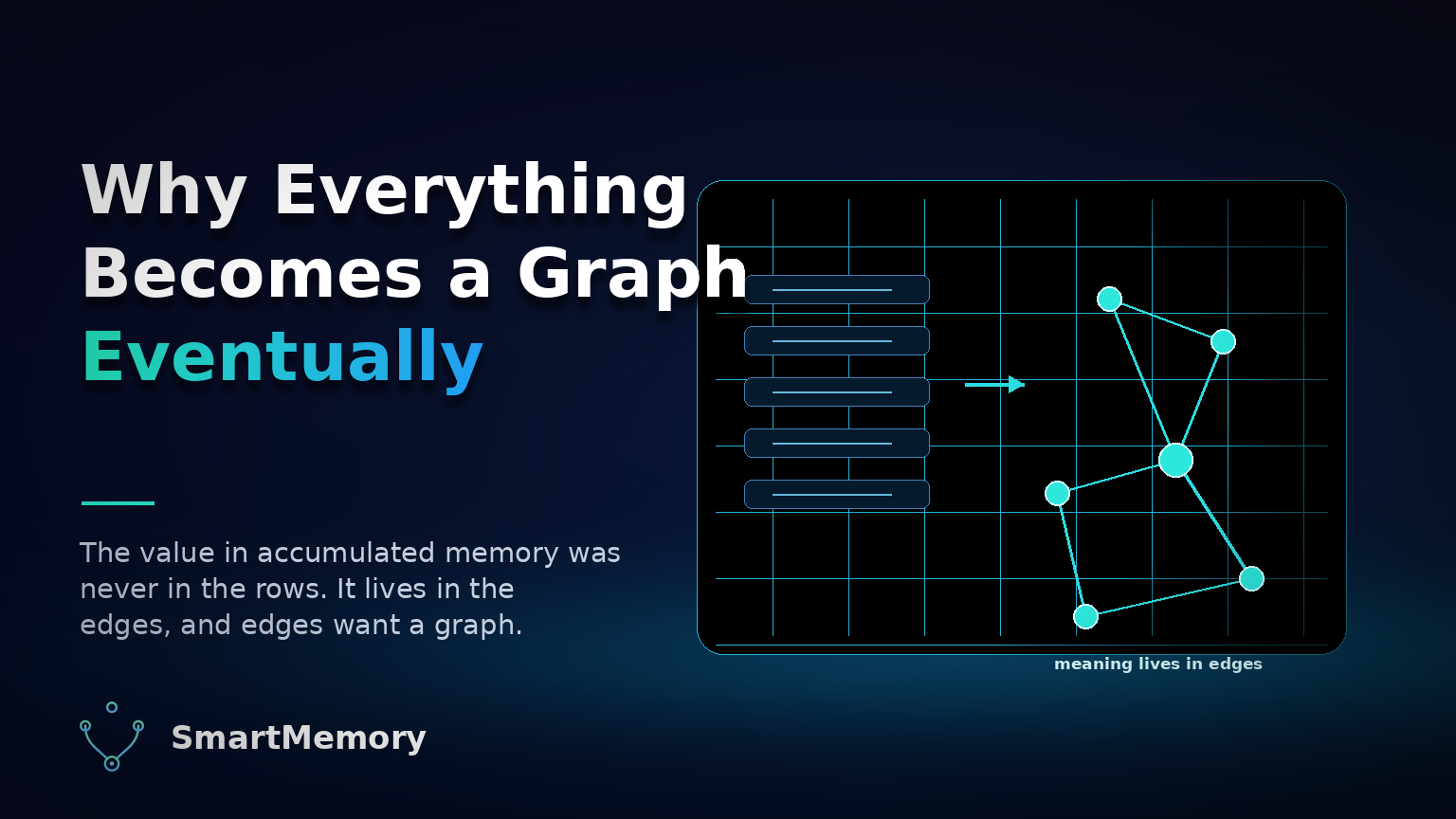
The value in accumulated memory was never in the rows. It lives in the edges, and edges want a graph.
The first version of almost every store I've shipped was a list. A flat table, a key-value bucket, a single index. Whatever was simplest, because at the start the data genuinely was that simple. It never stayed simple. Within a quarter or two the data had piled up, and the questions people were asking of it had quietly changed underneath us. They had stopped asking about the items and started asking about the connections between the items: which order these happened in, which one depends on that one, which one replaced the other, who said this and whether they were allowed to. The day someone files a bug that can only be answered by walking from one record to another to a third, you are running a graph query, whether or not you have a graph. You are just running it badly, in application code, against a store that was never built to answer it.
I have watched that arc play out four or five times now, on different stacks at different companies, and it always lands in the same spot, which is what makes me think it isn't a stack preference so much as a law. Any store that lives long enough and gets asked hard enough questions converges on a graph, because the value in accumulated data was never sitting in the rows. It accrued in the relationships between them. That conviction is the single biggest reason SmartMemory (the expertise layer I'm building for AI agents) is graph-centric from the floor up, on FalkorDB, rather than a flat vector index with some metadata bolted on the side.
Vectors answer one question, and it isn't the hard one
Let me be fair to the vector index, because it is genuinely good at the job it has. A vector store answers similarity. You hand it a query, it embeds it, and it hands back the things whose embeddings sit nearby in some high-dimensional space. For "find me text that means roughly this," nothing beats it. That is a real and useful capability, and SmartMemory uses vectors too. FalkorDB is a graph and vector database, and similarity search is one of the retrieval paths.
But similarity is a question about content, and almost none of the failures I've chased in production memory systems were content failures. The fact that got retrieved was usually a perfectly good fact, well-written, properly stored, sitting at the top of the relevance ranking. It failed anyway, because something about its relationship to everything else had gone wrong, and a similarity score has no vocabulary for relationships. It cannot tell you which fact superseded which. It cannot tell you who asserted this one and whether they had the authority to. It cannot tell you what this fact depends on, or which larger thing it was a part of, or when it stopped being true. None of those are properties of the text. They live in the connections around the text. A flat index is precisely a store that threw those connections away to make room for the embedding.
Facts rarely fail in isolation. They fail because their relationships failed, and you can't see a relationship in a thing that only stores things.
Provenance is an edge, not a column
Here is the mistake that I think sits underneath most of the others. People treat provenance as a field. A column on the row. source = "user", source = "agent", a little string you stamp on at write time and hope to remember to read at retrieval. And for a while that works, because at first provenance really is just a label.
It stops working the moment provenance becomes relational, which it always does. The real provenance questions in a mature memory system are not "what is the source of this row." They are "this conclusion was derived from which observations, which were extracted from which conversation turn, which was asserted by which user, in which session." That is a chain. Every link in it is an edge to another node, and the thing you actually need to know (can I trust this enough to act on it) is a property of the whole path, not of any single node on it. You cannot answer it by reading a column. You answer it by traversing.
This is why provenance has to be first-class in the data model, not a decoration on top of it. In SmartMemory every memory item carries an origin, and origin isn't decorative. We sort origins into visibility tiers through an explicit policy, so a speculative derived memory a background process guessed at does not get recalled with the same authority as something a human actually typed. But the tier on the node is only half of it. The other half is that the derivation is a graph you can walk: when we surface a recalled item, we can trace the lineage that produced it rather than handing you a confident sentence with no parentage. A flat index throws that lineage away at write time. It keeps the conclusion and discards the chain that justified it. The chain was the only thing that told you whether to believe the conclusion.
Supersession is the edge nobody plans for
The single most expensive shortcut I see teams take is treating a fact as a thing you overwrite. New information arrives, you update the row, the old value is gone. It feels clean. It is a catastrophe, and it is a catastrophe specifically because it destroys an edge.
When a new fact replaces an old one, what actually happened in the world is a relationship: this superseded that, at this time, for this reason. If you overwrite, you keep the new node and delete the relationship, and now you cannot answer any of the questions that matter after the fact. You cannot ask what the agent believed last Tuesday, because last Tuesday's belief was clobbered. You cannot reverse a bad update, because you kept nothing to reverse to. You cannot explain why the current value is current, because the path that led here was overwritten one node at a time.
SmartMemory supersedes instead of overwriting. A new fact links to the one it replaces through an explicit supersession edge, the prior state is preserved, and the change is reversible because nothing was destroyed. Picture an agent that has stored "the primary database is in us-east-1." Six weeks later the team fails over to us-west-2 and the agent records the new region. Overwrite the value and you can never reconstruct why an incident from last month routed traffic the way it did. The agent will swear the database has always been in us-west-2, because that is the only state it kept. Supersede instead, and last month's belief is still sitting on the other end of the edge, timestamped, exactly as the agent held it then. The same shape shows up wherever truth evolves: an evaluation that re-scores an agent's performance supersedes the prior score through a typed EVALUATED_BY edge rather than blowing it away, so you can still see what the agent was rated at before the run that changed your mind. Delete those edges and you have deleted your ability to audit, to reverse, and to explain. Those are the three things that make a memory system safe to operate.
Containment and dependency are edges too
Two more relationships that a flat store cannot represent, and that turn out to be load-bearing.
The first is containment. A conversation is not a bag of unrelated turns. The turns belong to it. When SmartMemory ingests a conversation, it builds a container node and links each chunk back to it with a PART_OF edge, so "this fact came out of that conversation" is a real, traversable relationship and not a coincidence of timestamps. The same PART_OF structure backs memory snapshots. A rollup that summarizes a window of activity is explicitly linked to the items it summarizes, so a summary never floats free of the things it claims to summarize. That matters because the most dangerous derived memory is the orphaned one: the confident summary whose sources you can no longer find. Containment edges keep the summary tethered to its evidence.
The second is dependency, and this is where the wedge of the whole product lives. Knowing what to do is relational in a way that knowing a bare fact is not. A decision does not exist on its own. It exists in relation to the alternatives it rejected, and a decision stripped of those rejected alternatives is just an opinion with no memory of why. A constraint relates to the things it governs. Lift it out of that relationship and it reads as an arbitrary rule nobody can defend. A lesson relates to the incident that taught it. Sever that edge and the lesson curdles into a superstition the agent obeys without knowing why.
Consider the near-miss version of this. Months back, an agent logs a sound architectural call: don't put the rate limiter in the API gateway, put it in the service, because the gateway is shared across three teams and a global limit there would throttle everyone at once. It stores the rule. It does not store the because. When a new engineer later asks the agent where rate limiting should go, it confidently repeats "in the service, never the gateway" and then defends it with a justification it invents on the spot, because the real one, the dependency on that shared-gateway constraint, was dropped at write time. The conclusion survived. The edge back to the reasoning that made it correct did not. A flat store keeps the what and loses the why, and the why was always an edge.
The relationship is what makes a memory safe to act on
Put those together and you get the real thesis, the one I only gestured at in an earlier essay and want to make fully explicit here.
A flat vector index can tell you what is similar. It cannot tell you which fact superseded which, who asserted it, what it depends on, or when it stopped being true. Those are exactly the edges that decide whether a memory is safe to act on. Similarity only ever tells you a fact is relevant. Whether it's actually current, whether the source had any standing, whether it even applies to the situation in front of you: none of that is in the embedding, and all of it is in the edges. An agent that retrieves on similarity alone is acting on relevance and quietly betting that the rest happens to hold. Most of the time they do. The times they don't are precisely the production incidents. The stale runbook that was true eight months ago, the user-asserted claim that quietly hardened into a settled fact, the derived guess recalled as ground truth. Every one of them is an edge that a flat store never had a place to keep.
And the place where you lose those edges is not retrieval. It's the write. This is the part teams get backwards. They reach for a graph at read time, trying to reconstruct relationships after the fact with a join here and a heuristic there. But if you didn't capture the supersession when the fact changed, the provenance when the fact was written, the containment when the conversation was ingested, the dependency when the decision was made, then there is no edge to traverse later. Context doesn't evaporate at read time. It evaporates at write time, silently, every time a system records a node and drops the edge it came in with. By the time you go looking for the relationship, the only honest answer the store can give is that it never kept one.
So you may as well start where you're going to end up
The graph is not an exotic choice you graduate to once you're sophisticated. It is the shape the problem has from the beginning. Flat stores just hide that shape until the data gets big enough and the questions get hard enough to expose it. Every team I've watched start flat and "add structure later" discovered that later is the most expensive possible time to add it, because by then the edges they needed are gone. Not misplaced, gone: never written, unrecoverable. You cannot retrofit a relationship onto data that was stored without it. You can only start collecting the edges from the first write, or spend the rest of the system's life approximating them.
That is the whole argument for building memory graph-centric, and it is why SmartMemory sits on FalkorDB rather than a vector index with metadata stapled on. The provenance chains, the supersession links, the PART_OF containment, the dependency relationships between a decision and what it rejected: these are not features layered over a memory store. They are the store. They travel with each memory because they were captured at the same moment the memory was, on the write path, where the edge is still in hand. The vectors are there too, doing the one job vectors are good at. But the thing that makes the memory safe to act on, the thing that distinguishes someone said this once from this is true, here, now, and here's why, was never in the embedding. It was always in the edges.
Which is really a claim about expertise, not about databases. Storing the facts an agent knows is the easy half. The half that makes an agent useful is knowing what to do with them, and what to do is never a free-standing fact. It only means anything held up against everything it connects to. You cannot keep that in a structure built to hold things one at a time, no matter how good its similarity search is. So I stopped fighting it. If a system has to remember anything that matters, it is going to grow a graph eventually. The only real decision is whether you start writing those edges down now, while you still have them, or go looking for them years from now and find the spot where they used to be.
I'm building SmartMemory, the expertise layer for AI agents: provenance-tagged, bi-temporal, graph-backed memory that knows not just what's true, but what to do, and when it stopped being true.
Try it: pip install smartmemory (docs) · hosted beta (private): smartmemory.ai/signup